The Rock Station
HISTORY
Located at the 550.290 km from Sydney, The Rock railway station was constructed as part of the extension of the main south railway line towards the NSW / Victorian border. NSW during the 1870s to 1880s witnessed a large expansion in voter’s demand for rail in the country regions. This led to a ongoing railway construction plan all across NSW and in the south, the Great Southern Railway arrived at Bomen (North Wagga) by 1878. 12months later the line then crossed the Murrumbidgee River, on what at the time was most expensive and longest rail bridge in Australia, to connect with Wagga Wagga. The next section of the Great Southern Railway saw a contract issued for the Wagga Wagga to Albury section awarded in 1878 to George Cornwell & F Mixner. This section of work included a new station at a location / stop called “Hanging Rock” and this opened on 1 September 1880. At the time of opening, the location of Hanging Rock was very small with only a few buildings and horse pulled coaches servicing out to Urana and within the region. The station name would change a few times over its early years, with opening as Hanging Rock, then renamed Kingston on 28 December 1882 followed by final change to The Rock on 10 February 1883.
INFRASTRUCTURE
Opposite the station in 1881 a goods siding was laid down along with building of a goods shed and a 5 ton jib crane. From 1892 stockyards were constructed in the yard and by the 190s a 20 ton goods weighbridge installed to facilitate goods movement as demand rose.
To the south of the station, in 1901 with the arrival of the steam locomotive depot, a Type E signal box was erected for the control of the line and yard and this also saw interlocked signalling at the station. This signal box remained until the 1985 and was then removed.
To the south is a 1909 built grain shed, where bags of grain used to be stored pending movement by rail. The shed had a concrete floor, open structure with galvanised iron roof. As grain needs expanded more by the 1920s, next to the grain shed saw new wheat silos built. In the mid 1910s increased handling wheat movements saw a loading bank built in the yard. The steam locomotives water supply was increasing and this saw by 1922 a new local dam built to supply water to the yard.
To the north of the station is located the Station Master’s House, Type 5 brick dating from 1880. As The Rock’s railway operations grew, the NSWGR built more railway houses to house the needed staff and by the 1930s new homes catered for the Assistant Station Master and a Night Officer.
TRAIN SERVICES
Passenger and goods hauled steam trains serviced The Rock and surrounding Riverina and southern NSW regions from 1880s until the late 1960s. From the late 1950s, The Rock became a railmotor depot, with NSWR assigning 4 CPH railmotors that were used on passenger services. Across the 1950s to 1970s, NSW railway passenger services and freight services declined as people moved to vehicles and this led to lesser trains being run and surrounding branch lines reduced in length or closed. With further train rationalisation taking place in the 1980s, the XPT took over all other passenger services on the main south line and this has remained this way. In the 2020s, The Rock railway station is only served each day by 2 XPT passenger trains operated by Sydney Trains, running Sydney to Melbourne and back to Sydney.
STATION
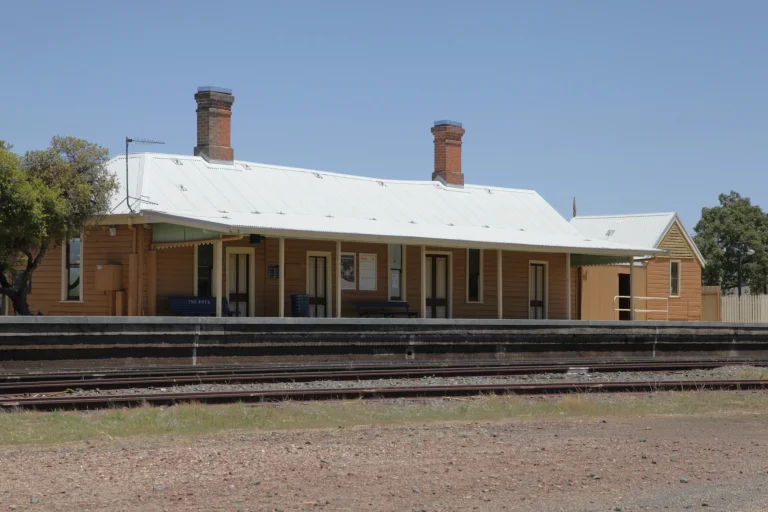
The Rock railway station is an example of 3rd class railway station design, constructed to a Type 4 style, dating from 1880. The building is built on a brick walled platform dating to 1880, the building is of timber construction with a large awning over the platform supported by timber columns. The structure is made from timber weatherbaord walls and has 2 brick corbelled chimneys and a corrugated iron roof. The original design only had 3 rooms but this changed over time, with the centrally positioned main waiting room extended to the roadside to give a prominent entry way. In the 1910s more extensions were made to the main passenger building. The Station Master’s office and ladies waiting room were located off to each side of the main waiting room. To the western end is a detached men’s toilet and a small yard between the two structures, giving an asymmetrical layout. The station layout was altered with the later addition of a room to the east.
JUNCTION STATION
By the early 1900s with demand for more railways needs in southern NSW, this saw more regional branch lines opening and The Rock railway precinct expanded in size, as it became a junction station for the newly built Oaklands branch line. This line opened to the west towards Lockhart in 1901 and then extended over time by 1912 to reach Oaklands. Interestingly Oaklands became one of only a few NSWGR stations also serviced by the Victorian Railways with dual gauge tracks installed. This branch line development saw a new steam locomotive depot, with a turn table, established to the north of The Rock railway station and a signal box was added to the station precinct.
By the 1920s, The Rock expanded again with a new branch line going south east to Westby. The need for a railway branch line to Pulletop and then later on to Westby, saw local passion and advocating for the railway line dated from early 1900s and it took until 1919, when the NSW Parliament finally enacted The Rock to Pulletop Railway Act. WW1 had caused large debt to NSW and this reduced government finance and the needed construction material to build the line and these factors delayed the line’s construction and opening until February 1923.
The Rock precinct with more junction work happening, saw new train infrastructure built as it became a localised rail depot to fix and store rolling stock. From the late 1950s, The Rock station also became a railmotor depot, for local CPH railmotors which moved passengers quickly and effectively along the main south line Junee to Albury and on the Oaklands, Rand, Holbrook and Kywong branch lines. These local regional railmotor passenger services stopped in 1974 and the depot was demolished in 1978. The nearby steam locomotive shed was removed in 1976.
REMAINS
By the 1980s The Rock’s operational needs was beginning to wind down with more infrastructure removed. By 1985 the signal box was removed along with the Assistant Station Master’s and Night Officer’s house. In 1986 the goods shed was removed, leaving only the yard crane to remind people what was once there. In the 2020s, The Rock’s only remaining infrastructure is the station building, the yard crane, the grain shed and the station masters house.